Adjustable bed guide
Malouf Adjustable Bases: Comparing Positioning, Controls, and Everyday Features
An adjustable base changes more than the angle of a mattress. It can reshape a familiar bedtime routine: lifting the head for a book, raising the legs to rest, or returning the bed to flat with a button press. Across Malouf’s E255, M555, S655, and S755 bases, the basic idea is shared, but the details diverge—in positioning range, massage, saved settings, and connected controls.
Comparing these models is easiest when features are considered as parts of daily use rather than as a long checklist. Which adjustments would you actually make? Do you want a quiet, simple remote, or app and voice controls? Would massage, under-bed lighting, head tilt, or lumbar support change how you use the bed? The answers help distinguish useful capability from features that may remain untouched.
What an adjustable base changes
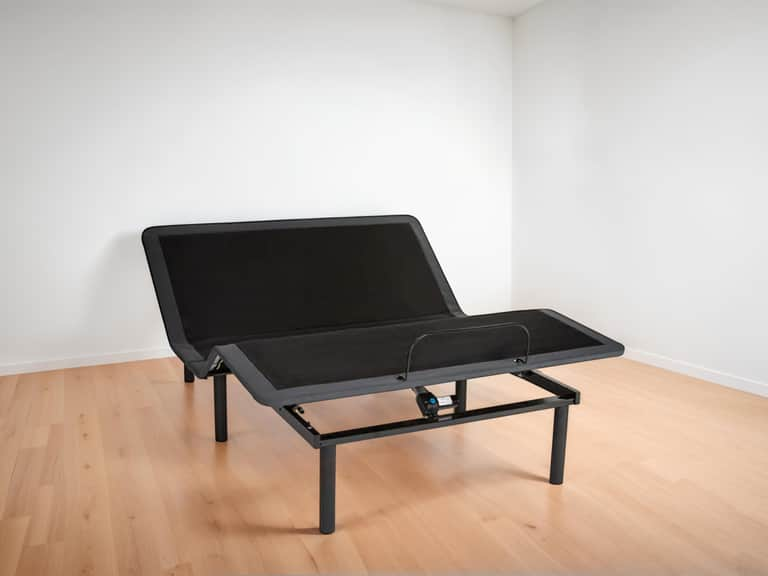
A conventional bed holds the mattress in one position. An adjustable base uses powered sections to raise or lower portions of the sleeping surface, typically at the head and feet. The mattress bends with the platform, creating positions for rest, reading, watching television, or settling in for sleep. Because the base and mattress move together, compatibility matters: not every mattress is designed for repeated articulation.
Head and foot adjustment are the foundation of the comparison. Independent movement means the head can rise while the foot section stays down, or both can be elevated to create a more reclined posture. Some bases add specialized movement, such as head tilt or lumbar lift. These options provide a finer range of positioning, but their value depends on the person and the way the bed is used.
It is also useful to separate a preset from a programmable position. A preset is a saved or built-in configuration—often labeled for a particular posture or activity. A programmable position lets a user store a preferred arrangement for quick recall. Neither term guarantees the same set of functions across manufacturers or models, so check the supplied remote and current product specifications before deciding what a feature name means in practice.
At a glance: four different feature profiles
| Model | Positioning and presets | Notable controls and conveniences |
|---|---|---|
| E255 | Independent head and foot lift; three preset positions and two customizable positions | Wireless remote; foldable design; Zero Gravity, Anti-Snore, and Flat presets |
| M555 | Independent head and foot adjustment; five presets and five programmable positions | Massage, Bluetooth and app control, Siri shortcut voice commands, USB ports, and under-bed lighting |
| S655 | Independent head and foot adjustment; head tilt; seven presets and six customizable positions | Massage, Bluetooth and app control, Siri shortcut voice commands, USB ports, and under-bed lighting |
| S755 | Independent head and foot adjustment; lumbar support and head tilt; multiple presets and programmable positions | ReachAssist, massage, app and voice controls, USB ports, under-bed lighting, and automatic snore detection |
Features and specifications can vary by size, configuration, or product revision. Confirm current details, including preset counts and included accessories, with the model documentation before purchase or installation.
E255: straightforward elevation with a compact feature set
The E255 centers on the essential movement: independent head and foot incline. Its listed range is up to 60 degrees at the head and 45 degrees at the foot. That gives users room to test different combinations, from a slight lift to a more pronounced recline, without requiring a separate specialized control system.
Three preset positions—Zero Gravity, Anti-Snore, and Flat—provide quick starting points. Two additional programmable positions let a user save preferred settings. The practical advantage is reduced repetition: rather than adjusting each section from scratch, the remote can call up a familiar arrangement. Preset names should be understood as position labels, not as a promise of a medical result. If a particular posture is being considered for a health concern, professional advice is more appropriate than relying on a setting name.
The E255’s wireless remote keeps operation direct. The available information does not list the app, voice control, massage, or integrated USB features found on some of the more feature-rich models, so buyers should not assume those are included. Its foldable construction and stated ability to sit on a foundation, platform, slat frame, or the ground may be relevant where storage or placement flexibility matters. Check the manual for the exact setup permitted in a specific room.
For someone who mainly wants head-and-foot positioning and a few saved settings, the E255 presents a comparatively uncomplicated approach. The useful question is not whether it has fewer features, but whether the missing features would meaningfully improve the everyday routine.
M555: presets, massage, and connected controls
The M555 builds on basic articulation with a broader set of conveniences. Its head section can incline up to 60 degrees and the foot section up to 45 degrees. Five preset positions are listed: Zero Gravity, Anti-Snore, Lounge, TV, and Flat. Five additional programmable positions provide room to store frequently used combinations.
Massage is one of the model’s distinguishing everyday features. The supplied description lists 12 dual-zone massage options. Rather than treating that number as a measure of therapeutic effect, think of it as a range of settings to explore for comfort and relaxation. The feel of vibration can vary with mattress construction and the person lying on it, so the stated feature does not guarantee that everyone will enjoy it or experience the same sensation.
For control, the M555 includes a backlit wireless remote and supports Bluetooth and smartphone app use, as well as Siri shortcut voice commands. That variety creates options: a physical remote may be simplest at night, while an app can be convenient when a phone is already nearby. Connected features also introduce practical considerations—pairing, app availability, device compatibility, and access to a charged phone. The remote remains important even for households that use voice or app controls.
USB charging ports on both sides of the base and under-bed LED lighting extend the feature set beyond movement. Lighting can help make a low bed easier to navigate at night, while charging ports keep compatible devices within reach. These are conveniences, not substitutes for checking outlet access, cable routing, and the room’s layout. The base also has a child-lock safety feature, which households should understand and use according to the manual.
The M555 can be a natural point of comparison for people who want more than elevation but do not specifically need the S655’s head-tilt adjustment or the S755’s lumbar and ReachAssist features. Its combination of saved positions, massage, connectivity, and practical add-ons is most relevant when those functions are likely to be used regularly.
S655: head tilt and a broader set of saved positions
The S655 shares much of the M555’s connected-control approach while adding a head-tilt feature. Alongside independent head and foot movement, the tilt adjustment offers another way to change the angle supporting the head and neck. That distinction may matter to someone who spends time reading or watching a screen in bed and wants to fine-tune the upper-body position. It is a positioning option, not a guarantee of improved posture or relief from discomfort.
The published feature information lists seven preset positions and six customizable positions. Presets include options such as Zero Gravity, Anti-Snore, and Flat, with the exact set worth confirming for the particular size and current configuration. A larger selection can make it easier to move between different activities, but only if the names and stored arrangements make sense to the user. Many people may settle on one or two favorites; others may appreciate having more choices available.
Massage, Bluetooth and smartphone app controls, Siri shortcut voice commands, USB charging ports, and under-bed LED lighting are also listed. The S655’s massage is described as offering nine dual-zone combinations. Compare this detail with the M555’s stated 12 options carefully: a higher number alone does not reveal how intense, comfortable, or useful the experience will be. If massage is a deciding feature, look for current specifications and, where possible, an opportunity to assess the sensation with a compatible mattress.
In practical terms, the S655 may suit routines that benefit from a more adjustable upper section. If head tilt would rarely be used, its presence may not be a meaningful reason to choose it over a simpler model. If a precise reading or lounging posture is part of nearly every evening, the extra movement could be more relevant than another preset or decorative convenience.
S755: lumbar support, ReachAssist, and additional automation
The S755 places specialized support and movement coordination at the center of its feature profile. It is described as offering independent head and foot adjustment, head tilt, and lumbar support. Lumbar lift changes the support beneath the lower back, adding a degree of adjustment beyond raising the main sections of the bed. This can make the position feel more tailored, but comfort is individual, and a more complex adjustment is not automatically the right one for every sleeper.
ReachAssist is intended to move the bed back as it inclines, helping keep the user closer to the nightstand. The practical appeal is easy to picture: when a base pivots, the upper body may otherwise travel away from a bedside surface. The mechanism’s usefulness depends on room arrangement, nightstand placement, and how the base is installed. Measure the space around the bed and follow setup instructions rather than assuming that every nightstand position will remain convenient through the full range of movement.
The S755 also lists massage, USB ports, under-bed lighting, app and voice controls, and automatic snore detection. The available description refers to seven preset positions and six programmable positions in its main overview, while individual feature summaries may phrase the preset count differently. Because product details can change and descriptions can vary, verify the current control functions and number of saved positions for the specific model before relying on them.
Automatic snore detection is presented as a feature that can detect snoring and adjust the bed position when needed. Treat it as an automated convenience, not as diagnosis or treatment. Snoring may have different causes, and a position change cannot establish whether a medical issue is present. Anyone concerned about persistent or disruptive snoring should seek appropriate clinical guidance.
Among these four models, the S755 has the most specialized feature profile in the supplied descriptions. Its strongest differentiators are lumbar adjustment, ReachAssist, and automatic response features, rather than simply having more buttons. Those functions make most sense when they address a real need in the room or routine.
How to compare positioning in real life
Feature lists describe what a base can do, but a short routine is a better test of what matters. Consider three moments: settling in to read, finding a position for sleep, and returning the bed to flat in the morning. At each point, ask whether separate head and foot movement is enough, whether a saved setting would save time, and whether head tilt or lumbar support would offer a useful refinement.
- For simple adjustment: Compare how the head and foot sections move and how easily they return to flat.
- For regular routines: Look at the number and type of presets, then check how many personal positions can be saved.
- For reading or screen use: Consider whether head tilt would help you find a comfortable upper-body angle.
- For personalized lower-back positioning: Review what the lumbar adjustment changes and how it is operated.
- For bedside access: Check ReachAssist and measure the relationship between the moving base and nightstand.
Try not to compare preset counts in isolation. A clearly labeled Flat button, an easy-to-use remote, and a reliable return-to-flat function can be more valuable than several settings that are hard to identify. Similarly, the range of motion matters only if it remains comfortable with the chosen mattress and bedding.
Controls: remote, app, and voice
A control system is part of the bed’s everyday ergonomics. A wireless remote is useful when it is easy to reach, its buttons are legible, and common actions are straightforward. Backlighting can help in a dark room. Before settling on a model, inspect or research the remote layout and determine how presets, manual movement, massage, and lighting are accessed.
App control can add an alternative interface, but it relies on a compatible smartphone and a functioning connection. Voice commands may be convenient when hands are occupied, yet they depend on setup, supported services, and the surrounding environment. Consider whether these controls would simplify the routine or merely add another device to manage. It is sensible to keep a physical remote accessible even when connected features are available.
Preset and programmable-position labels should also be distinguished. A named preset provides a ready-made option; a customizable memory position stores an arrangement chosen by the user. If two people share a bed, discuss whose preferences a saved position reflects and whether both sides adjust independently. Split configurations can change how partners manage movement, so confirm the size and setup rather than assuming that the same controls apply to every version.
Compatibility, capacity, and placement checks
Before comparing comfort features, make sure the base fits the mattress and the room. Confirm the mattress manufacturer’s guidance for adjustable foundations, including any limits on bending or articulation. A mattress that is not designed to flex may not perform as intended on a moving platform. Bedding should also fit securely through changes in position; deep mattresses and thick pads can affect the way sheets stay in place.
Check the base dimensions against the bed frame or room footprint. The listed dimensions of a base may differ from the nominal mattress size, and an adjustable mechanism needs clearance as it moves. Verify whether the base is intended to sit on a platform, a slat foundation, a pedestal, or directly on the floor. Some models describe several placement options, but the manual and current manufacturer guidance should determine the safe arrangement.
Weight capacity is another essential specification. Compare the stated limit with the combined load of the mattress, sleepers, and any other weight the manufacturer says should be counted. The product descriptions for these Malouf models list capacities ranging from 750 to 850 pounds depending on model and size; confirm the applicable limit for the exact configuration. Never infer capacity from a model name or from the appearance of the frame.
Finally, plan for power and cables. Identify a nearby outlet, avoid pinched cords, and ensure that moving components have room to operate. If the bed will be positioned close to a wall or nightstand, examine how articulation changes the space between the mattress and surrounding furniture. A careful measurement before assembly can prevent an otherwise avoidable mismatch.
Choosing by everyday priorities
A useful comparison begins with priorities, not with the longest feature list. The E255 focuses on independent elevation, basic presets, and programmable positions. The M555 adds connected control, massage, lighting, and charging. The S655 includes those kinds of conveniences while adding head tilt and a larger selection of listed positions. The S755 emphasizes specialized support and coordinated movement, with lumbar adjustment, ReachAssist, and automatic snore detection among its distinguishing features.
To narrow the field, rank features in three groups: essential, useful, and unlikely to use. Essential features might include a particular adjustment or compatibility requirement. Useful features may be massage or USB access. Unlikely features are the ones that sound impressive but do not connect to a regular habit. This simple exercise helps keep a technology-rich purchase grounded in actual use.
Also consider who will operate the base. A straightforward remote may be preferable for someone who wants buttons rather than an app. In a shared room, under-bed lighting or quiet operation may matter more than a wider set of presets. In a smaller bedroom, ReachAssist and nightstand spacing may deserve close attention. The best fit is the one whose movement, controls, and installation match the room and the people using it.
A final checklist before deciding
- Confirm the current feature list for the exact model, size, and configuration.
- Check mattress compatibility and any requirements for repeated flexing.
- Verify dimensions, placement options, leg configuration, and room clearance.
- Compare weight capacity with the total load, using the manufacturer’s definition.
- Identify which presets are built in and which positions can be programmed.
- Review remote controls, app compatibility, voice-command requirements, and backup operation.
- Check the details of massage, lighting, USB ports, child lock, and any automated functions.
- Read the warranty and setup instructions, and plan cable routing before assembly.
Malouf’s adjustable bases share the ability to reshape a bed’s position, but each model puts emphasis in a different place. The E255 keeps the experience relatively direct; the M555 broadens it with connected controls and everyday conveniences; the S655 adds head tilt and more saved positions; and the S755 brings specialized adjustments and automation into the picture. Compare those distinctions against actual habits, then verify compatibility and current specifications. That is a more dependable route to a base that feels useful long after the novelty of its controls has passed.
Frequently asked questions
Which Malouf adjustable base has head tilt?
The S655 and S755 descriptions include head tilt. This adjustment allows more refinement around the upper section than basic head-and-foot elevation alone. Confirm the current model specification for the configuration being considered.
Do all four models have app or voice controls?
No. App, Bluetooth, and Siri shortcut voice control are described for the M555, S655, and S755. The E255 information emphasizes a wireless remote. Check current documentation for any changes or regional differences.
Is a preset the same as a programmable position?
No. A preset is a built-in position, while a programmable position lets the user save a preferred arrangement. The available count and operation differ by model, so consult the remote guide for exact details.
Should I choose a base based on its massage or snore feature?
These features may be useful conveniences, but they should not be treated as medical care or guaranteed solutions. Consider whether they fit your routine, confirm how they work, and seek professional advice for persistent health concerns.